
How Google Ads Run is one of the most important things to understand when you want to promote a business online. Every day, millions of people search on Google for products, services, and answers to their questions. Businesses use Google Ads to reach these people when they are actively looking for something.
Table of Contents
Imagine you own a clothing store and someone searches for “best men’s shirts online.” With a properly planned Google Ads campaign, your store’s advertisement may appear among the sponsored search results. This gives potential customers an opportunity to discover your products without already knowing your brand.
Google Ads is useful for small businesses, online stores, service providers, and large companies. However, running advertisements without understanding how the platform works can lead to unnecessary spending.
In this guide, we will explain Google Ads step by step, including campaign creation, keywords, bidding, targeting, budgets, and performance tracking.
How Google Ads Run and Why Businesses Use Them
Google Ads is an online advertising platform developed by Google. It allows businesses to promote their websites, products, and services across Google Search, YouTube, and other advertising placements.
When someone searches for a product or service, Google may display relevant advertisements alongside organic search results. These advertisements are usually identified with a Sponsored label.
One of the biggest advantages of Google Ads is that businesses can reach users who are already interested in what they offer.
For example, a digital marketing agency in Delhi can advertise for searches related to digital marketing services. Instead of showing advertisements to everyone, the agency can focus on people searching for relevant services.
Google Ads also provides control over advertising budgets, audience targeting, and campaign performance.
How Google Ads Run Through the Advertising Auction
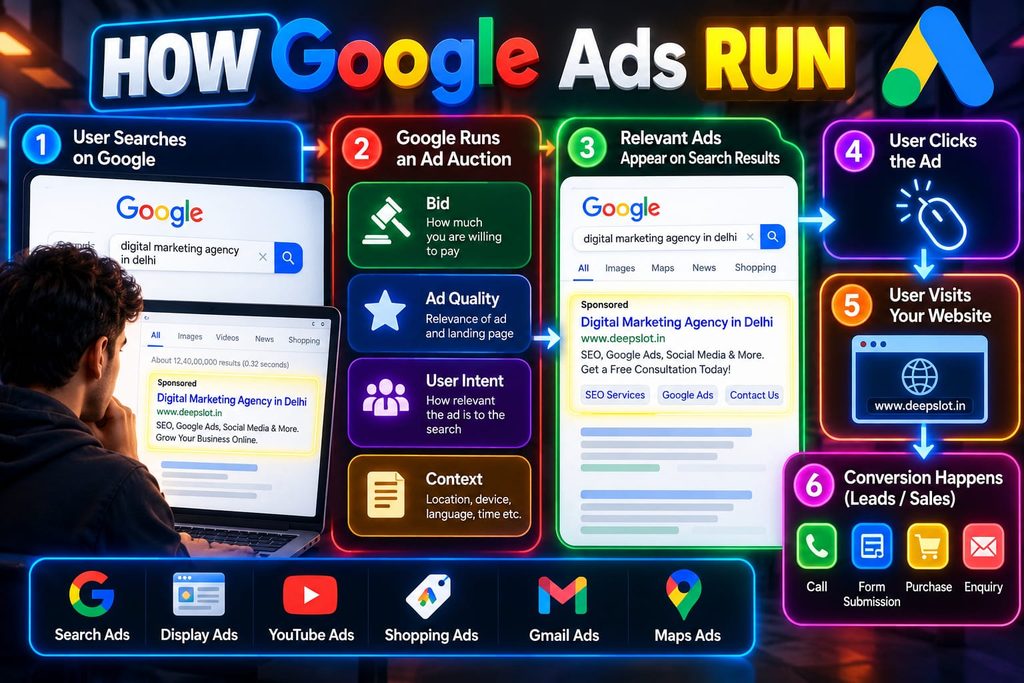
Google Ads uses an auction system to decide which advertisements are eligible to appear and how they are ranked.
When someone performs a search, Google evaluates eligible advertisements based on several factors, including bids, ad quality, expected impact of ad assets, and the context of the search.
Many beginners believe that the advertiser offering the highest bid will always appear first. However, this is not necessarily true.
Google also considers the relevance and usefulness of advertisements and landing pages. A well-written advertisement connected to a useful website may compete effectively against advertisers with larger budgets.
How Google Ads Run Using Keywords and Search Intent
Keywords help Google understand which searches are relevant to an advertising campaign.
For example, a business offering website design services might target keywords such as:
- Website design services
- Professional website developer
- Affordable business website
- Website development company
Choosing keywords requires understanding search intent. Someone searching for “what is website design” may simply want information, while someone searching for “hire website designer” may be closer to making a purchase.
Businesses should choose keywords based on their goals rather than selecting popular keywords without considering customer needs.
How Google Ads Run: Step-by-Step Campaign Setup
Creating a Google Ads campaign becomes easier when you understand the basic process. Beginners should start with a clear business goal and a manageable advertising budget.
How Google Ads Run When Creating Your First Campaign
The first step is creating a Google Ads account and choosing a campaign objective.
Google provides objectives such as sales, leads, website traffic, and brand awareness. The available options depend on the campaign type.
For example, an online store may focus on increasing purchases, while a local service business may want customers to submit enquiry forms.
After choosing an objective, advertisers select a campaign type.
Common campaign types include Search, Display, Video, Shopping, and Performance Max.
Search campaigns are often a practical starting point for businesses that want to reach people actively searching for their services.
How Google Ads Run With Daily Budgets and Bidding
Google Ads allows advertisers to set an average daily campaign budget.
Suppose you choose an average daily budget of ₹500. Your approximate monthly spending limit for most campaigns would be ₹15,200, calculated using Google’s average month of 30.4 days.
Actual daily spending may vary. For most campaigns, Google can spend up to twice the average daily budget on certain days while applying the relevant monthly spending limit.
Bidding strategies determine how Google optimizes advertisements.
Common strategies include:
- Maximize Clicks: Focuses on generating website visits.
- Maximize Conversions: Focuses on getting valuable customer actions.
- Target CPA: Aims to generate conversions at a specified average cost.
- Target ROAS: Focuses on conversion value relative to advertising spend.
Choosing the right strategy depends on campaign objectives and available conversion data.
How Google Ads Run With Audience Targeting
Audience targeting helps advertisers reach people who may be interested in their products or services.
Google Ads offers targeting options based on campaign type, including location, language, demographics, audiences, and keywords.
For example, a Delhi-based digital marketing agency may want to focus its Search campaign on customers in Delhi NCR rather than advertising across the entire country.
This can help the business concentrate its budget on a more relevant market.
How Google Ads Run With Location and Device Targeting
Location targeting allows businesses to select specific cities, regions, or countries.
A restaurant might advertise within its delivery area, while an online business could target several states.
Device performance is another important consideration.
Some customers prefer browsing on mobile phones, while others complete purchases on desktops. Advertisers can review device performance and make suitable adjustments where supported.
Google Ads also provides scheduling options that allow eligible campaigns to show advertisements during selected days and hours.
How Google Ads Run With Relevant Ad Copy
Ad copy is the message potential customers see when they encounter an advertisement.
Effective advertisements communicate what a business offers and why someone should choose it.
For example, a digital marketing agency might use the headline:
“Digital Marketing Services in Delhi”
The description could explain the agency’s SEO, paid advertising, and website marketing services.
A clear call to action, such as “Request a Free Consultation,” can encourage interested users to visit the website.
However, advertisements should avoid misleading promises or unrealistic guarantees.
How Google Ads Run and How Advertisers Pay
Google Ads supports different charging methods depending on campaign type and advertising goals.
One common model is pay-per-click, or PPC.
Under CPC-based pricing, advertisers pay when someone clicks their advertisement rather than simply when it appears.
For example, if a campaign receives 100 clicks at an average cost of ₹10 per click, the total click cost would be approximately ₹1,000.
However, actual advertising costs depend on competition, bidding, ad quality, and other auction factors.
Some campaigns use impression-based or video-related charging methods instead.
How Google Ads Run With Quality Score
Quality Score is a diagnostic measurement available for Search keywords.
It helps advertisers understand how their advertisement quality compares with that of other advertisers.
Quality Score is based on three components:
- Expected click-through rate
- Ad relevance
- Landing page experience
A relevant advertisement should lead visitors to a page that matches their expectations.
For example, an advertisement promoting SEO services should ideally direct users to a useful SEO service page rather than an unrelated homepage.
Quality Score itself is not a direct input into the ad auction, but its components can help identify opportunities to improve campaign quality.
How Google Ads Run With Conversion Tracking
Conversion tracking measures valuable actions people take after interacting with advertisements.
These actions may include purchasing a product, submitting a contact form, making a phone call, or signing up for a service.
Without conversion tracking, advertisers may know how many clicks they receive but struggle to understand whether those clicks generate business results.
Businesses can use Google Ads conversion tracking and Google Analytics to better understand customer activity.
How Google Ads Run Better With Campaign Optimization
Launching a campaign is only the beginning. Successful advertising requires regular monitoring and improvement.
Advertisers should review search terms, keyword performance, conversion data, and advertising costs.
If an advertisement receives many clicks but generates few enquiries, the problem could involve the landing page, targeting, offer, or website experience.
How Google Ads Run With Negative Keywords
Negative keywords help prevent Search advertisements from appearing for certain irrelevant searches.
For example, an agency offering paid SEO services might exclude searches containing “free” when those searches do not match its business goals.
This can help reduce wasted clicks and improve the relevance of incoming traffic.
Advertisers should regularly review search term reports and add negative keywords where appropriate.
How Google Ads Run With Landing Page Optimization
A landing page is the website page customers visit after clicking an advertisement.
An effective landing page should load quickly, work properly on mobile devices, and explain the advertised service clearly.
It should also provide an easy way for visitors to take action.
A confusing website can lose potential customers even when the advertisement itself performs well.
How Google Ads Run Compared With SEO
Google Ads and search engine optimization both help businesses attract visitors from Google, but they work differently.
Google Ads provides paid visibility and can begin generating traffic soon after eligible advertisements are approved and start serving.
SEO focuses on improving a website’s organic visibility through helpful content, technical improvements, and other optimization practices.
Google Ads requires ongoing advertising expenditure, while SEO generally takes longer to develop results and requires continued effort.
For many businesses, combining Google Ads with SEO can support both immediate marketing goals and longer-term organic growth.
Conclusion: How Google Ads Run for Business Growth
Understanding How Google Ads Run helps businesses make better advertising decisions and manage their marketing budgets more effectively.
From choosing keywords and creating advertisements to setting budgets and tracking conversions, every step contributes to campaign performance.
Google Ads does not guarantee sales, but careful planning, relevant targeting, useful landing pages, and regular optimization can improve the chances of reaching potential customers if you want to skyrocket your knowledge then [click here]
For businesses looking to strengthen their online presence, Deepslot offers digital marketing services focused on helping brands connect with relevant audiences.
Whether you are starting a new business or improving an existing marketing strategy, learning how Google Ads works is a valuable step toward building a stronger digital presence.